Tuesday, April 28, 2009

The Green House of the Future Includes GSHP

The Wall Street Journal asked architects to draw up plans for the most energy-efficient houses they could imagine. They imagined quite a bit.

What will the energy-efficient house of the future look like?

It could have gardens on its walls or a pond stocked with fish for dinner. It might mimic a tree, turning sunlight into energy and carbon dioxide into oxygen. Or perhaps it will be more like a lizard, changing its color to suit the weather and healing itself when it gets damaged.

Those are just a handful of the possibilities that emerged from an exercise in futurism. The Wall Street Journal asked four architects to design an energy-efficient, environmentally sustainable house without regard to cost, technology, aesthetics or the way we are used to living.

The idea was not to dream up anything impossible or unlikely -- in other words, no antigravity living rooms. Instead, we asked the architects to think of what technology might make possible in the next few decades. They in turn asked us to rethink the way we live.

"This is a time of re-examining values, re-examining what we need," says one of our architects, Rick Cook, of the New York firm Cook + Fox. "We are re-examining the idea of home."

A fresh look may be long overdue, given the amount of damage that homes can do to the environment. It's easy to envision a power plant spewing pollution or a highway full of cars burning billions of gallons of petroleum. But buildings -- silent and unmoving -- are the quiet users of much of our energy, through electricity, heating and water consumption. The U.S. Energy Department estimates buildings are responsible for 39% of our energy consumption and a similar percentage of greenhouse-gas emissions.

The growing awareness of that fact helps explain why green building is one of the most pervasive trends in the construction industry -- even as the economy struggles and home-building is at its lowest level in a generation.

So, how will the green homes of tomorrow help solve the energy puzzle? Here's a gander into the future.

"I'd love to build a house like a tree," says architect William McDonough of the Charlottesville, Va., firm William McDonough + Partners. And that's what he set out to do here.

The surface of his house, like a leaf, contains a photosynthetic layer that captures sunlight. Unlike today's solar panels, which are often pasted above a roofline, these are woven into the fabric of the exterior. They heat water and generate electricity for the home -- and create oxygen for the atmosphere, to offset carbon produced in other areas of the home.

Mr. McDonough envisions a sleek, curved roof with generous eaves to provide shade, which lowers the heat load in summer, thereby reducing the need for energy-hogging air conditioning. The roof also insulates and provides an outdoor garden. (Mr. McDonough designed a similar "green roof" for a Ford Motor Co. factory -- one of the first large U.S. buildings with that design.)

The "bark" of the treelike house would be thin, insulating films that would self-clean and self-heal, Mr. McDonough says, thus avoiding the need to replace them after years of exposure to the elements.

William McDonough + Partners envisions its house like a tree. The "bark" of the house is made up of thin, insulating films that would self-clean and self-heal if damaged. A curved roof with large eaves provides shade, which lowers the heat load in summer. The "trunk," or the frame of the home, consists of carbon tubes, while the "roots" are a heat-pump system buried in the yard.

It sounds far-fetched, but some of these technologies already exist. Self-cleaning glass, for instance, has a special coating that uses ultraviolet sunlight to break down organic dirt; rainwater then washes the filth away.

Self-healing paints that contain microscopic capsules of color are in use on some car paint, for instance. These vessels break open when the surface of the paint is scratched to repair the damage. Similar ideas could expand to repair other materials such as glass or cladding.

The "trunk" -- or the frame of the home -- would eschew wood or metals. Instead, lightweight, "resource efficient" carbon tubes would keep the structure standing upright.

Finally, the "roots" of the home would be a ground-source heat-pump exchange system buried in the yard. It would take advantage of the relatively constant temperature of the soil to control the home's climate -- bringing in heat in winter, when the ground is warmer than the surrounding air, and cool in the summer, when the ground's temperature is lower. Such systems exist today, but cost puts them out of the reach of most homeowners. (Until GroundSource Geo debuts next year...-ed.)

MORE

Tuesday, April 21, 2009

Going Back to School for Earth Day


When it comes to promoting energy efficiency and our part to play, we value all aspects of the educational pipeline. Last week, Dennis Murphy was part of a provacative discussion entitled "Integrating the Clean Tech Value Chain." This MIT/Stanford VLAB Emerging Business Forum was produced by GroundSource mentor Ron Long, moderated by Dan Lankford of Wavepoint Ventures and hosted by Cooley, Godward. Quite a good time was had.

Not to be outdone, Palo Alto's trailblazing El Carmelo Elementary School will be the hub of Earth Day afternoon Expo activities. GroundSource was invited by Deloitte/CTO/PTA member Brian Goncher to explain heat pump mechanics to children and their parents. We look forward to many "aha" moments, despite the absence of a cute heat pump mascot.

Thursday, April 16, 2009

Bob Potter's Deep Pursuit of Hot Dry Rocks

"Drill, baby, Drill"
BY: Todd Woody @ grist


A veteran of the Manhattan Project is developing technology that could make it easier to tap geothermal energy locked deep underground.

[disclosure: GroundSource Geo is affiliated with Potter Drilling]

It’s the archetypal Silicon Valley story: Unknown entrepreneur toils away on a Big Idea in an anonymous office park until discovered by one of the Valley’s legendary deep-pocketed investors.

Another boy wonder CEO hatching the next Twitter or Facebook? Not quite. Meet Bob Potter, 88. He started his hardware company when he was just 83 with technology that grew out of his work on the Manhattan Project (yes, that Manhattan Project) back in the 1940s at Los Alamos National Laboratory in New Mexico.

It’s all about bits, not bytes. Bits as in drill bits. Potter Drilling is developing a deep-drilling technology to tap geothermal heat miles below the earth’s surface—heat that could be used to generate carbon-free electricity.

Conventional geothermal power plants draw upon underground aquifers of hot water relatively close to the surface to create steam that drives electricity-generating turbines. The problem is that underground water currently tapped for geothermal is found mainly in the western United States. But the technology Potter is developing could drill much deeper, meaning geothermal energy could be generated nationwide.

According to a 2006 MIT study, so-called Enhanced Geothermal Systems could potentially supply 2,500 times the country’s current energy consumption. That grabbed Google’s attention, and last August the Internet giant’s philanthropic arm agreed to invest $4 million in Potter Drilling as part of its green energy initiative.

The tech twist: Potter drills not with hard-as-diamonds bits but with water—extremely hot water. (More on that in a bit.) The goal is to radically cut the cost of EGS to spread the technology to regions that rely too much on coal for generating electricity but are not suited for solar, wind and other renewable energy generation.

“It is fun to see some old dreams come true,” says Potter standing in the company’s Redwood City lab-slash-workshop in a light-industrial park wedged in between Interstate 101 and the railroad tracks. He has just pulled into the parking lot after making the 1,200-mile drive up from his home in New Mexico (with a side trip to Fresno to visit his 95-year-old brother).

Tall and lean and partial to bolo ties, Potter looks as much a western rancher as a rocket scientist. He is in fact one of the fathers of EGS. Starting in the 1950s, Potter and colleagues at Los Alamos began investigating the potential of fracturing pockets of super-heated rocks located deep beneath earth’s surface. Their idea: Inject water in the fractured rock and pump the hot water to the surface to create steam to drive a turbine. The water is then re-circulated back underground in a closed loop.

But Potter soon encountered a major obstacle to making geothermal as common as coal: Drilling as deep as six miles below the earth’s surface is incredibly expensive, presenting a host of obstacles to overcome. Even conventional geothermal developers spend millions of dollars to just drill test wells. But EGS rigs must penetrate miles of hard rock that slows drilling to a crawl. And a broken drill bit 30,000 feet underground can force the abandonment of a $10 million well.

“Getting into the drilling was forced on us in a way because that was thing that really prevented hot fractured rocks from being viable,” says Potter.

When government funding of geothermal research dried up with the crash of oil prices in the early 1980s, Potter moved on to other endeavors. But in the late 1990s he returned to geothermal, and with MIT chemical engineering expert Jefferson Tester patented a drilling technology called hydrothermal spallation. Potter then persuaded his son Jared to start a company in 2004 to commercialize the technology and serve as its CEO.

The younger Potter holds a Ph.D. in geology from Stanford University and had already started two Silicon Valley geological-related companies. Potter Drilling limped along for a few years, unable to interest the Valley’s venture capitalists to fund basic R&D on something that seemed so, well, industrial and old economy.

Then Google came calling on a recommendation from Tester. “If Google hadn’t come along, the company would have died,” says Jared Potter, 56.

What sealed the Google deal was a demo of Potter Drilling’s technology like the one I’m about to see. We’re standing in front of a contraption that looks like a prop from the original “Star Trek.” Salad plate-sized analog gauges line either side of the seven-foot-tall U-shaped device. Suspended in the center is a silver container about the size of small beer keg connected to various tubes and valves.

More

Wednesday, April 15, 2009

Are ultracapacitors the key to making hybrids king of the auto market?

The Dark Horse in the Race to Power Hybrid Cars

By Larry Greenemeier Scientific American

MEAN GREEN MACHINE: An ultracapacitor-equipped Toyota Supra HV-R coupe was the only hybrid to win the 24-hour endurance race held at Japan's Tokachi International Speedway. Courtesy of Toyota Motor Sales, U.S.A., Inc.

The greatest victory so far for the cars, fueled by a combo of electricity and gas, came just weeks ago when an ultracapacitor-equipped Toyota Supra HV-R coupe became the first hybrid to win the 24-hour endurance car race held at Japan's Tokachi International Speedway. The hybrid Supra finished 616 laps of the 5.1-kilometer (roughly threemile) course—19 more laps than the second-place nonhybrid Nissan Fairlady Z. "The Toyota that won was able to deliver energy more quickly, accelerate faster, and use braking generation more efficiently," says Kevin Mak, an analyst with research and consulting firm Strategy Analytics and author of a recent study that explores the potential for ultracapacitors to complement and possibly even replace batteries in hybrid vehicles. "The days of the large hybrid vehicle battery pack may be numbered," he adds.

The reason, he says: capacitor technology that stores energy in the electric field between a pair of closely spaced conductors. An ultracapacitor, also called a supercapacitor, is an electrochemical capacitor with a higher energy density than normal capacitors, which potentially makes them a better fit for hybrid vehicles.

Ultracapacitors store electricity by physically separating positive and negative charges. Batteries store energy using toxic chemicals and their effectiveness fades over time. In addition, recycling the heavy metals in batteries is a difficult task. Capacitors, on the other hand, are constructed of much smaller fine carbon nanotubes, Mak says.

A major advantage of ultracapacitors is their ability to efficiently capture electricity from regenerative braking systems and provide that electricity to power a car's acceleration. Ultracapacitors not only charge more quickly than batteries, they also release energy more quickly, Mak says.

A drawback to their use is the technology's inability to store as much energy as a battery. But the Tokachi race proved that ultracapacitors could be more widely used in conjunction with smaller batteries to power hybrid cars. "Without the need for chemicals, capacitors can be lighter, thereby enabling the hybrid car maker to improve fuel economy further and reduce costs," Mak says. "The low weight would then make hybrid power trains more readily available to compact car segments as [has been] seen on Honda and Mazda concept cars since 1997."

MORE


Saturday, April 11, 2009

Introducing iBone


Congratulations to GroundSource Geo friend Tom Scharfeld for the unleashing of the iBone trombone app."Our aim is to produce something playable, practicable, and fun," said Tom."With iBone, we've brought the (trom)Bone and the band to the phone so users can make music, have fun, and even learn wherever they may be."

Visit http://ibone.spoonjack.com for video and images. iBone is available in the iTunes App Store now with an introductory price of $2.99.

Thursday, April 9, 2009

Cap & Trade: Two Views, a Correction and a Modest Proposal


Thomas Friedman: Show Us the Ball

Representative John B. Larson, chairman of the House Democratic Caucus, has circulated a draft bill that would impose “a per-unit tax on the carbon-dioxide content of fossil fuels, beginning at a rate of $15 per metric ton of CO2 and increasing by $10 each year.” The bill sets a goal, rather than a cap, on emissions at 80 percent below 2005 levels by 2050, and if the goal for the first five years is not met, the tax automatically increases by an additional $5 per metric ton. The bill implements a fee on carbon-intensive imports, as well, to press China to follow suit. Larson would use most of the income to reduce people’s payroll taxes: We tax your carbon sins and un-tax your payroll wins.

People get that — and simplicity matters. Americans will be willing to pay a tax for their children to be less threatened, breathe cleaner air and live in a more sustainable world with a stronger America. They are much less likely to support a firm in London trading offsets from an electric bill in Boston with a derivatives firm in New York in order to help fund an aluminum smelter in Beijing, which is what cap-and-trade is all about. People won’t support what they can’t explain.

Michele Bachmann: Lost jobs, big hikes in your bills -- that's cap-and-trade

President Obama has repeatedly said he will not raise taxes on low- and middle-income families, yet his policies do not match his rhetoric. Take for instance, a new tax he has proposed on the use of energy. It's called cap-and-trade or, more appropriately, cap-and-tax. The tax would require energy producers and businesses to pay to emit carbon emissions in the hope of reducing greenhouse gases.

The Democrats need the revenue this will generate to pay for their expensive agenda. But getting it this way would be shortsighted because it will cost far more in the long run than it will bring in. While the president originally estimated that implementing this plan would cost $646 billion over eight years, his deputy director for the National Economic Council, Jason Furman, recently stated that it could cost up to three times that -- bringing the cost closer to $2 trillion.

Any way you look at it, it's low- and middle-income Americans who will pay dearly for this. According to an analysis by the Massachusetts Institute of Technology, the average American household could expect its yearly energy bill to increase by $3,128 per year. Using an analysis by Peter Orszag, President Obama's budget director, that number would be closer to $4,000.

MIT Scientist: Republicans Misusing My Climate Change Paper


Apparently from this M.I.T. study, which found that a cap-and-trade plan along the lines of the one envisioned by the Obama administration would raise $366 billion a year at the outset. In reality, many of those costs will be passed on to consumers, but those costs will be offset by rebates and conservation and efficiency measures and the transition to other fuel sources and so on. In fact, the exact same study concluded that the actual costs to consumers would begin at $31 a year--or $79 per family.

Gilbert Metcalf in Technology Review

A leading economist explains why a carbon tax is the best strategy for cutting greenhouse gases and the use of fossil fuels.

The MIT Joint Program on the Science and Policy of Global Change

Tuesday, March 31, 2009

Long May You Run: Electric Car Killer on Life Support

From Nate Silver's excellent fivethirtyeight.com blog:
Let's take something of a 30,000-foot view on the condition of General Motors. The chart below details GM's operating margin -- its profits divided into its revenues -- over the past 50 years (below).


I haven't provided the dates on the chart because they aren't important. The auto business is highly cyclical because consumers are buying expensive assets that last for years at a time. Nobody ever really has to buy a new car (they can buy a used one if their car breaks down), and therefore consumers are willing to hold on to their existing vehicles and wait out economic slumps. You can't do that with, say, a loaf of bread, or even something like a cellphone, which has a much shorter lifespan.

But you knew all of that already. The remarkable thing is that, once you account for the economic cycles, the trend for GM is exceptionally steady -- an exceptionally steady trend downward. There were still bad times thirty years ago -- but they weren't bad enough to threaten GM's survival, and conversely, the good times were much better. These are General Motors' operating margins by decade:
Average Annual Operating Margin, General Motors
1960s: 8.7%
1970s: 5.5%
1980s: 3.0%
1990s: 1.3%*
2000s: -0.5%
* Excludes one-time $20 billion accounting charge for retiree health benefits in 1992.
If I were an alien beaming down from Rigel-3 looking at this pattern -- an alien with an MBA degree -- my first guess is that it would reflect some sort of systemic problem, some chronic imbalance that magnified over time. Something, in other words, like the costs of GM's retiree pension and health care programs. It's difficult to get a precise figure on these so-called legacy costs, but they averaged about $7 billion per year between 1993 and 2007 and are probably at least $10 billion per year now. Considering that GM has never made as much as $10 billion in profit in a year and that its entire operating lossses in 2008 were $13.8 billion, you can see why this is a significant problem.


From
How To Save A Major Automobile Company by Neil Young of LincVolt in Huffington Post

Find a new ownership group. The culture must change. It is time to turn the page. In the high technology sector there are several candidates for ownership of a major car and truck manufacturer. We need forward looking people who are not restricted by the existing culture in Detroit. We need visionary people now with business sense to create automobiles that do not contribute to global warming.


It is time to change and our problems can facilitate our solutions. We can no longer afford to continue down Detroit's old road. The people have spoken. They do not want gas guzzlers (although they still like big cars and trucks). It is possible to build large long-range vehicles that are very efficient. People will buy those vehicles because they represent real change and a solution that we can live with.

The government must take advantage of the powerful position that exists today. The Big 3 are looking for a bailout. They should only get it if they agree to stop building autos that contribute to global warming now. The stress on the auto manufacturers today is gigantic. In order to keep people working in their jobs and keep factories open, this plan is suggested:

The big three must reduce models to basics. a truck, an SUV, a large family sedan, an economy sedan, and a sports car. Use existing tooling.

Keep building these models to keep the workforce employed but build them without engines and transmissions. These new vehicles, called Transition Rollers, are ready for a re-power. No new tooling is required at this stage. The adapters are part of the kits described next.

At the same time as the new Transition Rollers are being built, keeping the work force working, utilize existing technology now, create re-power kits to retrofit the Transition Rollers to SCEVs (self charging electric vehicles) for long range capability up to and over 100mpg. If you don't think this technology is realistic or available, check out the Progressive Insurance Automotive X prize. Alternatively, check out Lincvolt.com or other examples.

A bailed out Auto manufacturer must open or re-purpose one or more factories and dedicate them to do the re-power/retrofit assembly. These factories would focus on re-powering the Transition Rollers into SCEVs but could also retrofit and re-power many existing vehicles to SCEVs. These existing vehicles are currently sitting unsold at dealerships across America.

Auto manufacturers taking advantage of a government bailout must only sell clean and green vehicles that do not contribute to global warming. No more internal combustion engines that run exclusively on fossil fuels can be sold period.

No Big Three excuses like "new tooling takes time". New tooling is not a requirement for SCEV transition rollers.

Build only new vehicles that attain the goal of reversing global warming and enhancing National Security.

Government legislation going with the bailout should include tax breaks for purchasers of these cars with the new green SCEV technology. The legislation accompanying the bailout of major auto manufacturers must include directives to build only vehicles that attain the goal of reversing global warming while enhancing National security, and provide the financial assistance to make manufacturing these cars affordable in the short term while the industry re-stabilizes.

Eventually the SCEV technology could be built into every new car and truck as it is being assembled and the stop gap plan described above would have completed its job of keeping America building and working through this turbulent time.

Detroit has had a long time to adapt to the new world and now the failure of Detroit's actions is costing us all. We pay the bailout. Let's make a good deal for the future of America and the Planet. Companies like UQM (Colorado) and others build great electric motors right here in the USA. Use these domestic electric motors. Put these people to work now. This plan reverses the flow from negative to positive because people need and will buy clean and green cars to be part of World Change. Unique wheel covers will identify these cars on the road so that others can see the great example a new car owner is making. People want America to win!

This plan addresses the issue of Global warming from our automobiles while enhancing our National Security and keeping Detroit working.

Neil Young, activist (Bridge School, Farm Aid) rock legend, has assembled a team that is in the process of transforming his gargantuan 1959 Lincoln Continental from a gas guzzler into a showcase for green technology and sustainability. The car will be entered into the Automotive X Prize that offers a $10 million prize to develop a vehicle that can get 100 miles per gallon or better. The almost 50 year old Lincoln, one of the biggest, heaviest production cars of all time, has been re-named "Linc Volt" and is the subject of a feature documentary called "Repowering The American Dream" that is now in production under the aegis of Young's Shakey Pictures. New york times article link.

Friday, March 20, 2009

Jobs, Jobs, Jobs...City Hall in San Jose


"Clean Tech Open Stretches its Reach, Adds More Prize Money"

From:
Silicon Valley / San Jose Business Journal 3.20.09
By: Lisa Sibley

Clean Tech Open Executive Director Rex Northen on Thursday unveiled the nonprofit’s newest challenge — and it goes far beyond its initial endeavor of connecting entrepreneurs with a network of vendors and funding.

Northen said the Open’s goal is to create 100,000 jobs in 10 regions by 2015.

To accomplish this, Northen said, “We need to take the best of Silicon Valley and bring it to the rest of the nation. It’s about giving regional players access to venture capitalists and venture capitalists access to these businesses.”

San Jose Mayor Chuck Reed, an early champion of clean techology, jumped right on board. “ I am signing up for 25 percent of this cleantech challenge,” he said.

Reed announced his commitment to add 25,000 jobs to the industry at the launch of the fourth annual Clean Tech Open competition at the City Hall Rotunda.

This year’s competition will also be the richest with $1 million in regional prizes -- including a grand prize of $250,000 -- and will add two more regions to the field, the Pacific Northwest and the Rocky Mountains. Already 120 competitors have signed up in the three regions, which Northen said is ahead of schedule.

Since it began four years ago, the Clean Tech Open has spawned 125 companies, raised $125 million in capital and added 500 jobs.

GroundSource Geo, a 2008 winner and San Jose Environmental Business Cluster member, developed non-impact drill technology for ground-source heat pumps. GroundSource aims to be a major provider of green collar jobs locally, through equipment manufacturing and HQ operations -- as well as nationally by spurring streamlined installations of ground-source heat pumps throughout residential, commercial and institutional buildings in North America.

Tuesday, March 17, 2009

The Hub of Green Inventions: Clean Tech Open

By Natasha Chen, posted in Earthzine on March 17th, 2009

Dennis Murphy
Dennis Murphy

“I heard someone say on the news this morning that entrepreneurs are to bring us out of this recession. And with the help of the utilities’ social capital, we hope to help you guys do that. No pressure.”

Laughter erupted in a conference room after that comment from Robyn Zander, program manager of the California Public Utilities’ Technology Resource Incubator Outreach, or TRIO. She and fellow commissioners responsible for bringing in new, energy efficient technologies to public utilities were invited as guest speakers at a Clean Tech Open breakfast in Palo Alto, Calif. on Wednesday. California Clean Tech Open, an organization sponsoring a business competition for entrepreneurs in clean technology inventions, launches their 2009 contest on March 19. The goal is to help innovators go from a green idea to full-fledged business by connecting these contestants with mentors, potential customers and potential investors. Semi-finalists from this competition will go up against those from the Pacific Northwest and Rocky Mountains regions, and finalists compete for the nationwide prizes in October.

Rex Northen, the executive director of Clean Tech Open, said, “We are the organization that’s built the largest business competition in our space, and what we say by business competition or clean tech, is that we’re not just here to get their business plans written. We’re here to help them with creating an entire viable, fundable business out of what in most cases is a very small company. So we start with people who are in an embryonic stage…and we give them all the components of a real business.”

Clean Tech Open is expecting as many as 200 team applications for the California division, which will be whittled down to 45 semi-finalists. Those teams, along with the semi-finalists from the Pacific Northwest and Rocky Mountains competitions, will receive all the benefits of mentorship and guidance Then twelve finalists in six categories go to the national final competition, which will be held in San Francisco this fall. The six categories are in Air, Water & Waste, Green Building, Energy Efficiency, Renewable Energy, Transportation, and Smart Power (including smart grid applications and battery storage). Winners will receive what Clean Tech Open calls a “startup-in-a-box,” $100,000 worth of cash and services donated by sponsors to help the entrepreneurs launch their businesses.

Previous winners have included Nila Lighting, now responsible for lighting many of Hollywood’s blockbuster scenes. “[Nila] is an LED based lighting system. If you consider what goes on in a Hollywood studio, these are high intensity, heavy duty lights in the major studios in Hollywood…well you see they’re very very hot,” said Northen. “So what they do is they have an LED array, a very bright LED array that takes all their problems away. You can actually put your hand on this thing. And if all the movie studios in Hollywood were to use the Nila Lighting system, that would remove an entire power plant in a grid.”

Winner of last year’s sustainability prize and runner-up for the green building category, Dennis Murphy is the president and founder of GroundSource Geothermal, a company that enables drilling technologies for ground source heat pumps. “What we’re working on is technology to simplify the adoption of ground source heat pumps, which have been long considered the most effective way to heat and cool buildings. That was a joint assessment by the EPA and DOE back in ‘93,” Murphy said, addressing the entrepreneurs in the audience. “The problem has been, how do you do that? It’s essentially creating heat sinks in the ground. That involves drilling; it’s kind of a mess. So we’re working on that part – we’re working on making better holes in the ground.”

GroundSource Geo officially launched in September 2008 as a spin-off of a different company called Potter Drilling, and Murphy won the sustainability prize from Clean Tech Open in November. His company anticipates a hybrid franchise model in which they serve Northern California residential clients and then offer that to regional partners around North America. Murphy said, “One thing I can say is that no matter how well versed you are in a certain technology or field of study, that no one really knows everything about everything, especially when it comes to starting a business.”

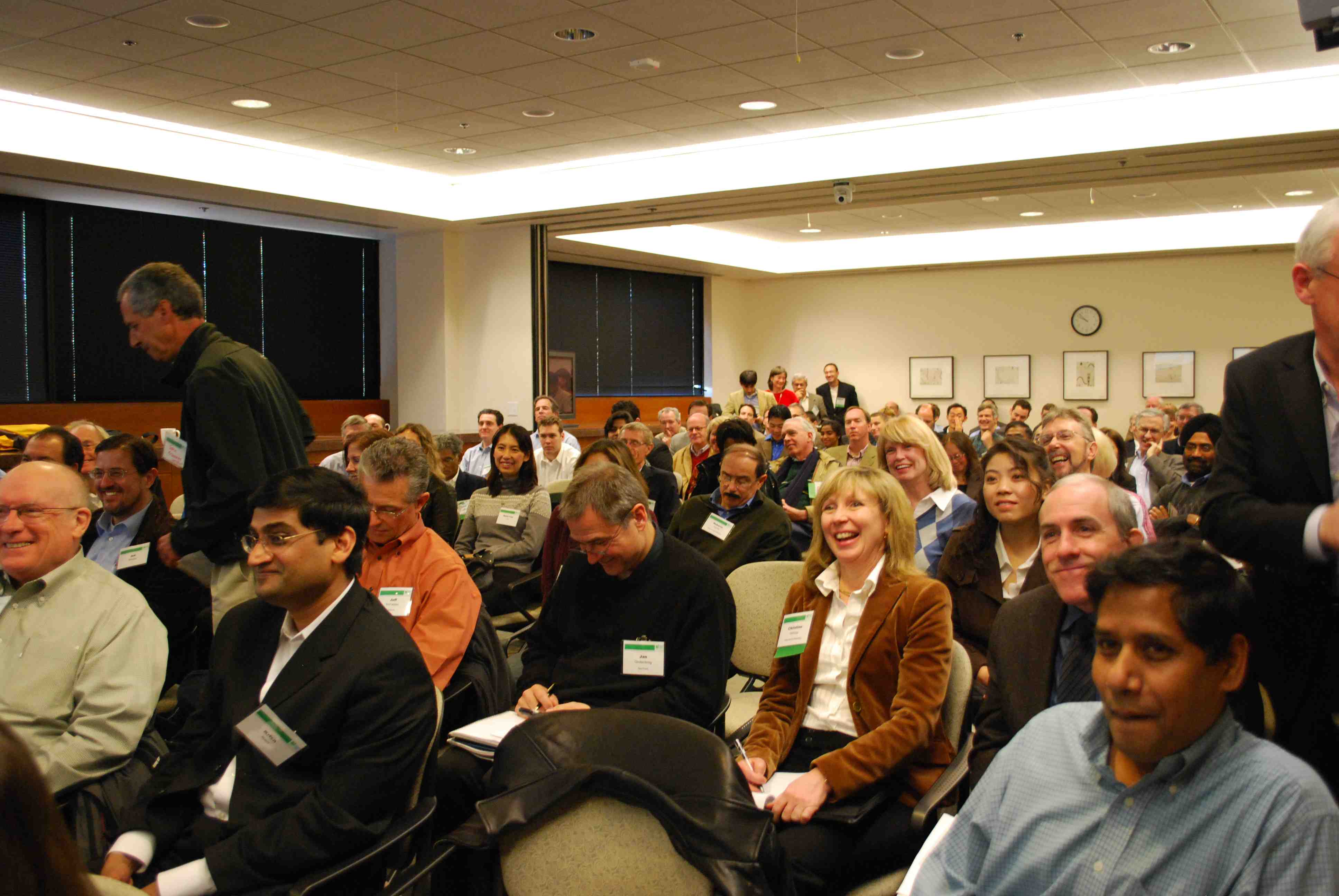
green crowd
A crowd of green entrepreneurs competed in the
California Green Tech Open (Photos by Natasha Chen)

That’s why Murphy said he was extremely appreciative of the support Clean Tech Open gave him in starting his business. Clean Tech Open is on Facebook, LinkedIn, and Twitter, but Murphy calls it an “old-fashioned social network” of people sharing common interests and goals. He especially values the guidance he received from Ron Long, a business model strategist for emerging clean technologies and the mentor matched to this project.

Long said that this year’s political climate affects that of entrepreneurship: “The new stimulus program is a perfect match for bringing the funding and the expertise in the green tech environment to help emerging businesses.” In regard to his own GroundSource Geo, Murphy added, “The stimulus package recently includes a 30 percent tax credit for residential heat pump installations, because they recognize the power of the demand reduction involved. It’s even better in bigger buildings, in commercial institutions. It’s basically a replacement for furnace and air conditioning as usual.”

Northen recognized that this year’s competition occurs during a time of economic distress, and although none in attendance claimed to be investors, he has faith in the stimulus package in encouraging clean technology innovation.

In particular, Northen said he hopes to see leaps in development of smart power. “There’s a lot of money in the stimulus for smart grid applications,” he said. “Applications that plug into a smart grid will be very, very important. There is a saying that if you brought Alexander Graham Bell into today’s world, and showed him today’s telephone systems, he wouldn’t recognize them. But if you brought back Thomas Edison, who was one of the founding fathers of the grid, and get him to look at what we have today, he would recognize most of the components. So our grid has not moved on in a very long time. It’s very ancient technology.”

If necessity is the mother of invention, those at the Clean Tech Open breakfast made clear the great need for their products, currently in infancy but perhaps in full-fledged form by year’s end.